
Can documenting loss, absence, and search become a form of justice? Documentation practices led by families of the disappeared in Mexico
What role does documentation play in the pursuit of truth and justice in context of ongoing violence? In this new Justice Visions podcast episode, we take up this question by exploring documentation practices in Mexico, a context marked by an ongoing and deeply complex crisis of enforced disappearances. With more than 133,000 people officially registered as disappeared and numbers continuing to rise, families have become central actors in the search for truth and justice.
In this episode, co-hosts Amanda Rossini Martins and Büşra Cebeci speak with Anna Karolina Chimiak, whose work has been closely grounded in accompanying families of the disappeared since 2016. Drawing on both practice and research, Anna reflects on how families of the disappeared have placed documentation at the core of their strategies in a context marked by state-criminal collusion and the lack of effective institutional responses.
Zooming in on grassroots initiatives, the conversation highlights how families have stepped in to fill profound institutional gaps. In a context where violence is ongoing and state responses remain limited, fragmented, and ineffective, families have developed their own grassroots justice efforts by organising searches for the disappeared, mobilising collectively, advocating for policy reform, and documenting both the disappearance and the lives of their loved ones.
As Anna explains, these documentation practices are multifaceted: they range from personal archives and community databases to search flyers, memorialisation initiatives, and artistic expressions, documentation takes many forms.
“Families document to generate the information that institutions failed to produce and to build the evidence needed for search, for truth and for justice processes. But their objectives go far beyond that. […] Documentation is not only a technical activity, but also an act of resistance, of care, and of collective organisation.”
These practices also sustain memory, challenge official narratives, and make visible patterns of violence that might otherwise remain hidden. Through documentation, they build evidence and push for accountability beyond national borders. At the same time, as Anna notes:
“Families of the disappeared in Mexico rarely invoke the language of transitional justice explicitly. Instead, they mobilise narratives grounded in its core pillars: truth, justice, memory, non-recurrence, and reparation, adapting these frameworks to a shifting and often adverse context that they face”.
In doing so, families are not only responding to the crisis; they are actively reshaping what justice looks like in a context where violence persists and formal transitional processes remain limited. Their work expands the boundaries of transitional justice, grounding it in lived experience and everyday practices of love and care.
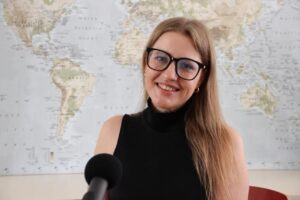
Anna Karolina Chimiak is a human rights lawyer and PhD researcher at the Human Rights Centre, Ghent University. Her research focuses on Mexico, where families of the disappeared have become central justice actors, placing documentation at the core of their strategies in a context marked by state-criminal collusion and the lack of effective institutional responses. By analysing these practices, she examines how family-led documentation produces and sustains forms of truth and justice in a setting that does not align with dominant transitional justice mechanisms, and how these practices interact with, challenge, and expand such frameworks from the ground up. Before joining the Human Rights Centre, she served as co-director of the Centro de Justicia para la Paz y el Desarrollo (CEPAD), a human rights organisation based in Jalisco state, Mexico, where she provided legal, political, and psychosocial accompaniment to families of the disappeared and victims of torture.
Photo Credit: Anna Karolina Chimiak